
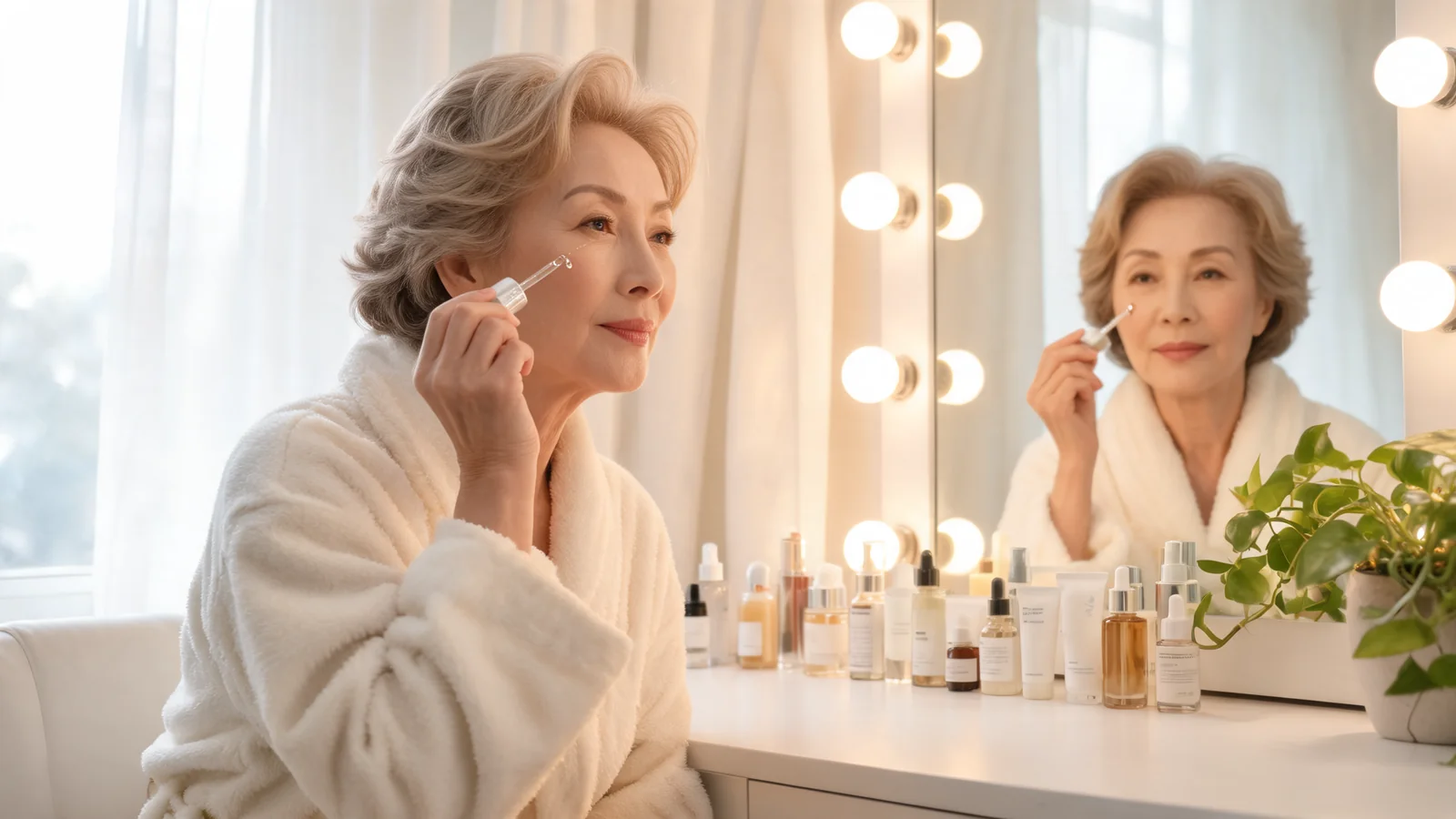
I have a drawer in my bathroom that contains, by my last count, 31 unfinished products. Serums I bought for a single ingredient. Creams I tried twice and gave up on. Eye treatments that promised a transformation in 14 nights and delivered, at best, a faint disappointment in 28.
This is normal for women my age. We grew up reading magazines that told us to layer six things every night. We have spent enough money on skincare in our adult lives to put a child through state college. And most of us, somewhere in our late 50s, have arrived at the same quiet realization: the routine I was sold is not the routine that works.
I am 58. Last spring I burned my drawer down to six products and a single device. Six months later, my skin looks better than it has in a decade. Here's exactly what I did and why, and what each thing earned its spot doing.
The Frustration That Started It
I had been doing the maximalist routine for years. Cleanser, toner, vitamin C, hyaluronic acid, retinol, peptide cream, eye cream, moisturizer, SPF. Nine steps in the morning. Eight at night. My bathroom counter looked like a beauty editor's desk drawer.
And my skin, honestly, was struggling. It looked dehydrated. It pilled under makeup. It felt sensitized in the cheeks and dry along the jaw. I would pull a new product off a magazine list and add it to the rotation, and a month later I would feel worse, not better.
The breaking point was a Wednesday in April. I caught a glimpse of myself in my daughter-in-law's hallway mirror, the kind of unflattering light most of us avoid, and I didn't recognize the texture I saw. Not lines. Lines I had made peace with. The texture, the dullness, the look of skin that had been overworked.
The Discovery
I called my dermatologist's office for the first time in three years, expecting to be told to add yet another prescription to the stack. What she told me instead was the opposite. She walked me through my routine, ingredient by ingredient, and quietly identified four products that were working against each other and one that was actively damaging my barrier.
She said something I'll repeat verbatim because it changed how I think about skincare: "After 50, the women whose skin looks best are doing fewer things, more consistently, with better products. Not more things, less consistently, with whatever's on sale."
That conversation, and the six months that followed, are the routine I'm about to share.
The women whose skin looks best after 50 are doing fewer things, more consistently, with better products. Not more things, less consistently, with whatever's on sale.
What I Use Now
Morning (Three Products, Two Minutes)
1. Paula's Choice RESIST Optimal Results Hydrating Cleanser. Gentle. Doesn't strip. The kind of cleanser you can use in your 60s without your skin rebelling.
2. Paula's Choice C15 Super Booster. Fifteen percent vitamin C, stable formula, brightens without irritating. I was a vitamin C skeptic for years. This one finally won me over.
3. A daily SPF 50. The single most important step. The only step I would never skip. Pick one you'll actually wear under makeup, and reapply at noon if you're outside.
Night (Three Products, Three Minutes)
4. The same gentle cleanser. Sometimes a second cleanse if I've worn heavy SPF or makeup.
5. Paula's Choice 0.3% Retinol + 2% Bakuchiol Treatment. Started low. Built up to four nights a week over three months. This is the product that changed my skin texture more than anything else in this routine.
6. A rich barrier moisturizer. Something with ceramides and squalane. I rotate between two depending on season.
The Device That Surprised Me
Three nights a week, before the moisturizer, I run a NuFace Mini 2.0 across my jaw, cheeks, and brow for five minutes. I bought it expecting it to be theater. After ninety nights of consistent use, I am, reluctantly, a believer. Not in a transformative way. In a measurable, your-jaw-looks-more-defined-on-Friday-than-it-did-on-Monday way.
The two things I'd start with if I had to do it over
If you're rebuilding from a maximalist routine, start with Paula's Choice for your daily basics (the cleanser and vitamin C above) and a microcurrent device three nights a week. That's where I'd put my first $250 if I were starting over today.
See Paula's ChoiceWhat Six Months Looked Like
Months one and two: my skin got worse before it got better. The retinol caused a low-level peeling along my chin and forehead. I dialed back to two nights a week, then built back up. By the end of month two, the peeling had stopped and my skin looked smoother than it had in years.
Months three and four: the texture changes settled in. Pores along my nose and cheeks looked smaller. The dullness along my jaw, the part I noticed in that hallway mirror, lifted. Makeup applied evenly for the first time in a long time.
Months five and six: the small things. My skin felt comfortable when I woke up, which had not been true for a long time. The papery feeling along my upper chest had softened. My husband, who has never noticed a single skincare product in 33 years of marriage, told me my face looked "rested." Reader, I almost cried.
The Things I Stopped Doing
This list is as important as what I added. I stopped using a separate eye cream (my facial moisturizer covers it). I stopped using a toner. I stopped using a separate hydrating serum because the right moisturizer covers that too. I stopped buying every new active that landed in my inbox. I stopped layering peptide and retinol and acid in the same evening. And I stopped skipping SPF on overcast days.
The Recommendation
If your bathroom counter looks like mine used to, the most powerful thing you can do for your skin in your 50s and 60s is to take everything off of it and rebuild from a base of three to six products you'll actually use every day. Pick a brand with formula transparency and a real return policy so you can test without committing. Add a device only after the routine is solid. And give it three months before you decide it's working.
This is not a sexy approach. It will not make for a great Instagram reel. It is, however, the routine that finally worked, and the one I would write down for any woman in this age range who has spent fifteen years trying everything else.
Build a routine you'll actually keep
Paula's Choice is the line I rebuilt mine around. Honest formulas, transparent ingredients, a 60-day return policy, and a tight enough catalog that you can build a real morning and night routine without ten unfinished bottles in the drawer.
Shop Paula's ChoiceAnd if you want the device that surprised me, this is the one I'd start with:
The microcurrent device worth trying first
The NuFace Mini 2.0 is the most forgiving entry into microcurrent at home. Smaller and cheaper than the Trinity, and the right starting point for most readers in their 50s and 60s.
See the NuFace Mini 2.0